
Three Telescopes, One Century
What fifty years of looking up has taught me about buying one.
In December 1975, in my grandfather's garden in London, I used a brass telescope to observe the moons of Jupiter. The telescope was already sixty-five years old at the time
It has since passed to me, via my father, and I still have it.
It is one of three telescopes I own, and between them they cover a little over a century of stargazing.
To be fair, none of the designs are new. All of them were invented in the seventeenth century and in regular use by the eighteenth.
What has changed in the last hundred years is the manufacturing process and the application of technology (especially IT) which have brought high-quality telescopes that are easy to use within the reach of everyone.
1910 — the one that started it all - Broadhurst and Clarkson, 2-inch
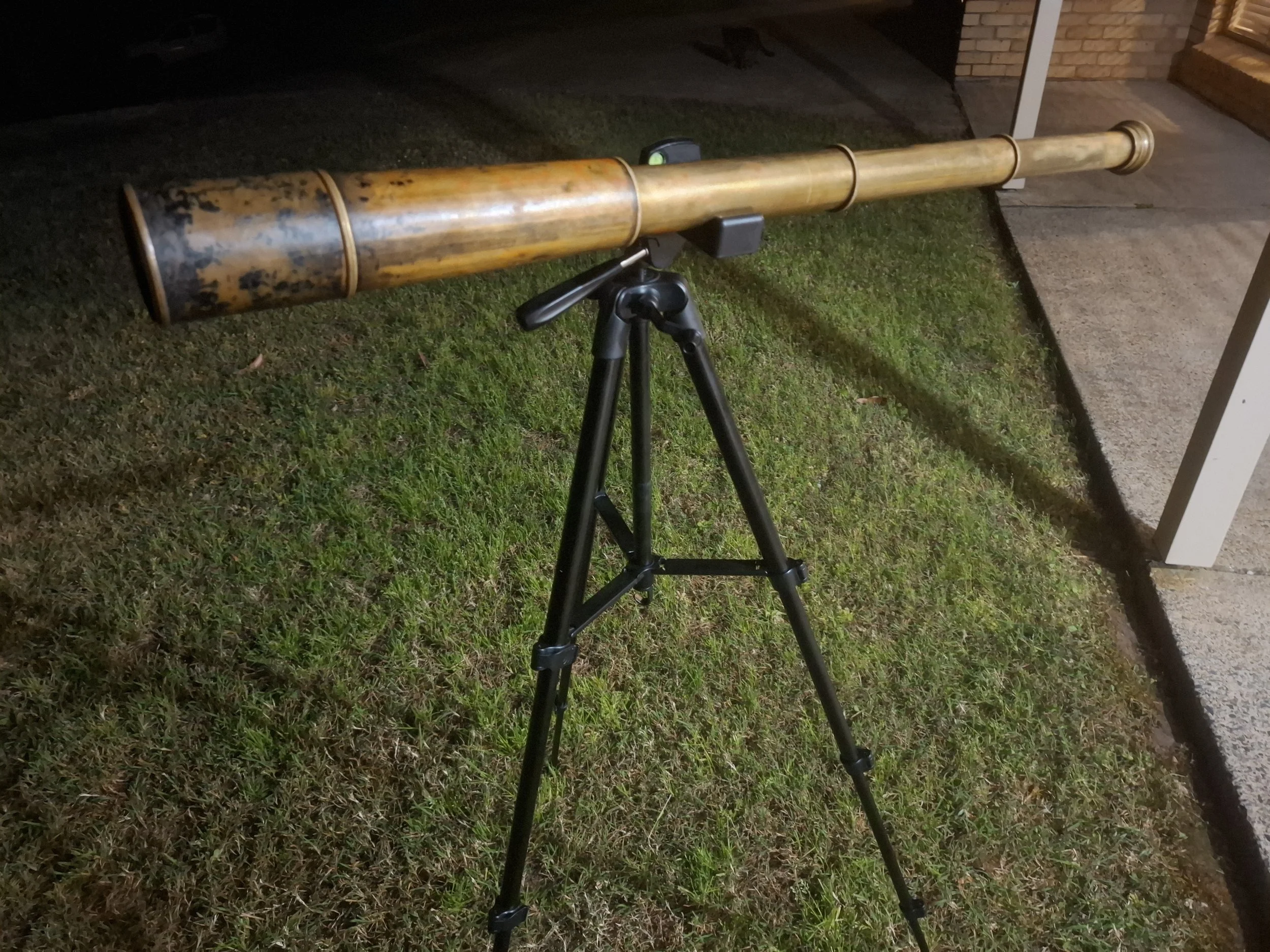
The B&C, about 1910. Four sections of solid brass, all made in-house.
A Broadhurst and Clarkson (B&C), manufactured around 1910, featuring a solid brass four-section expanding tube which was also manufactured in-house. It has a 2-inch diameter objective (main) lens, a focal length of 670mm and a single double-convex eyepiece with a focal length of 20mm, giving a magnification of 34x - considered a good "working" magnification.
The design makes it quite long, about 60 to 70cm, and it is quite heavy to use after even a few minutes.
This one is typical of the military-style mariners' scopes that were in use at the time.
They were popular with the British Navy because they were easy to maintain and could be significantly shortened for storage.
Many of these devices had pancratic (a precursor to Zoom) eyepieces, up to four on a rotating head similar to a microscope, which allowed several magnifications.
Mine only has the one, and can focus on objects down to about four metres away.
With a weight of 1.1kg (2.4lb), its original user would have needed a strong and steady right arm to take observations of the moons of Jupiter from a moving deck at night.
I had the considerable advantage of standing still.
1978 My first telescope: Tasco 4½-inch Newtonian
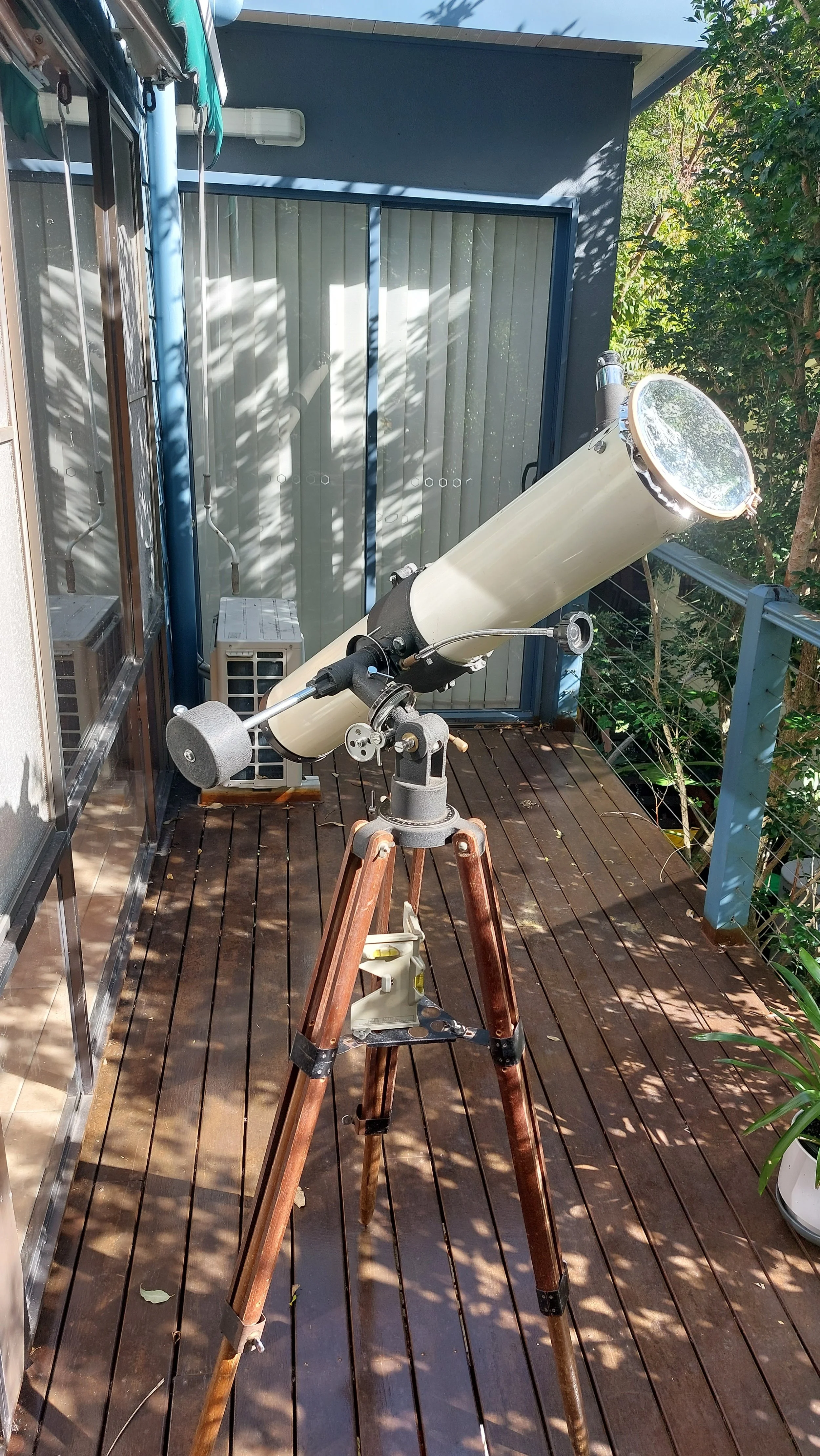
The Tasco, bought in 1978 and still in service.
In the 1970s Tasco was a major brand, and this unit featured a German equatorial mounting and a counterweight to balance the weight of the scope.
This meant the whole thing could be "driven", using a motor to keep pace with the rotation of the Earth. An undriven mount only required adjustment in one axis.
Importantly, the unit was lightweight, inexpensive, and easy to operate and maintain.
I still have this scope, and I still use it.
2004 — the first camera rig: Celestron C8 NexStar
A Schmidt-Cassegrain, and the first telescope I bought and equipped specifically for astrophotography.
The "NexStar" part was a fully integrated computer allowing automatic positioning and guidance of the scope while I focused on taking photographs.
At the time this involved taking short (or long!) videos, processing them using a stacker ( lining all the stars up frame by frame and getting rid of anything dodgy) and then finishing with an image compiler such as Photoshop.
This scope was sold in 2006.
2024 - what I use now : Celestron C6 NexStar Evolution
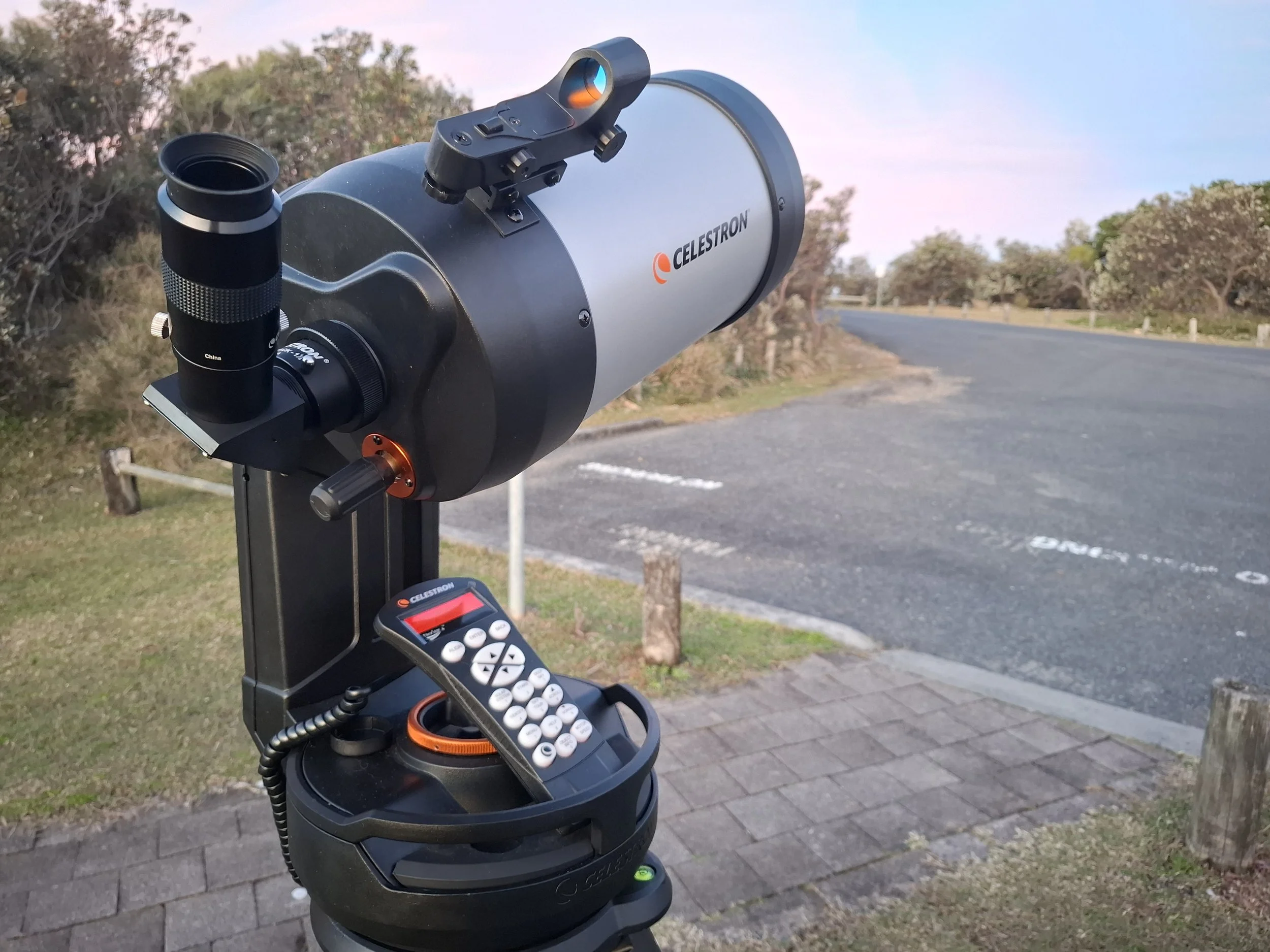
The C6. Small enough to travel, big enough to be worth setting up.
Another Schmidt-Cassegrain telescope (SCT).
The "Evolution" part is the ability to control the entire system from an app on a smartphone.
A clever adapter allows the phone to be attached directly to the scope to take pictures, with minimal adjustment once it is set.
By buying a slightly smaller unit than an "eight", I have struck a balance between power and portability.
The future?
Brands such as ZWO Seestar now market a compact telescope - 50mm and 30mm aperture - which does it all, including stacking and processing.
In light-collection terms this is a return to the smaller telescopes of the twentieth century, but with so much tech that the aperture limitations are, apparently, easily overcome.
I don't own one yet, so the jury is out, for me at least.
(I would love to take one for a test drive soon)
Thinking of buying one? Four things.
1. Optics are everything.
If you have poor-quality mirrors and lenses in your scope, nothing else matters.
Optics first, always. Do your research and avoid "shop specials" that sound too good to be true. They usually are.
2. Start small.
Learn the scope and its controls, and how to take photos. There are lots of publications and societies out there. Small size and portability mean you can set up anywhere, so you will actually use it regularly.
3. Stick to your budget, and know what you want to do with it.
Meade and Celestron are still up there, but there are lots of second- and even third-tier kits that are pretty close and often cheaper. Do your research.
4. Have fun.
I've owned a telescope for more than fifty years, and looking at the Moon, or at something you haven't seen before, just never seems to get old.
You don't actually need a telescope
All you really need is a good set of 10x50 binoculars, a clear sky and a star atlas or app - Stellarium is the current go-to for downloadable star atlases.
A dark backyard and half an hour is a perfectly good night's astronomy, and it costs nothing.
The sky is literally the limit. Enjoy.
Want to look through one of these?
Starry Night Tours runs small-group stargazing from Look At Me Now Headland at Emerald Beach, under some of the darkest sky on the Coffs Coast.
On tour you'll be looking through the Celestron C6
Bookings and dates are here on the What’s On page
The technical bit … for people who want the technical bit
Skip this if you like. It will still be here.
Objective: the lens or mirror which collects the incoming light for transfer to the eyepiece. Telescopes are essentially light buckets, so the bigger the objective the more you can see. The size of a telescope, usually expressed in inches, is the diameter of the objective.
Focal length: the distance between the objective and the point of focus.
Divide the focal length by the diameter of the objective and you get the focal ratio, or "f-number" - used in the same way as on a handheld camera. Run it the other way and the f-number multiplied by the objective gives you the focal length.
Eyepiece: the place you look to see the image, situated at the opposite end of the light path.
Magnification: the focal length of the objective divided by the focal length of the eyepiece.
Good working magnifications are between 30 and 50 times, and higher magnifications up to about 100 to 120 are good for a closer look.
If you are going above that regularly, consider getting a bigger telescope, as your images will be increasingly "lossy" at higher magnifications.
Newtonian reflectors: (Isaac Newton, 1643–1727) consist of a main curved mirror at the "bottom" of the tube which reflects light back up, where it is reflected by a side mirror into the eyepiece, mounted on the side near the "top".
Mirrors do not have chromatic aberration and are comparatively light next to lenses of a similar size, which is why all large professional telescopes are reflectors.
Schmidt-Cassegrain telescopes: (Laurent Cassegrain, 1629–1693) - the Cassegrain light path enters the telescope and is reflected off the objective mirror, back up to a secondary mirror.
The light is then returned back the way it came, through a hole in the objective mirror, to a focus behind. The Schmidt component is a corrector plate on which the secondary mirror is mounted, and whose function is to correct for spherical aberration.
This configuration is extremely popular in the amateur and professional fields today.
Starry Night Tours runs small-group stargazing from Look At Me Now Headland at Emerald Beach, under some of the darkest sky on the Coffs Coast.
You bring yourself, a jumper, the kids and questions- we’ll supply the hot chocolate & binoculars.
During School Holidays the Tours are running Tuesday to Saturday
( Regularly Friday & Saturdays nights)
Book Now
